
I never heard of Charlie Kirk until he was dead.
In recent years, I’ve made a point of staying away as much as possible from anything the least little bit political. But my Facebook feed blew up in waves of anger and jubilation after the man was assassinated, and I was instantly curious.
I’ve learned a lot about him since then. I’ve learned a lot about our society too, as well as about myself.

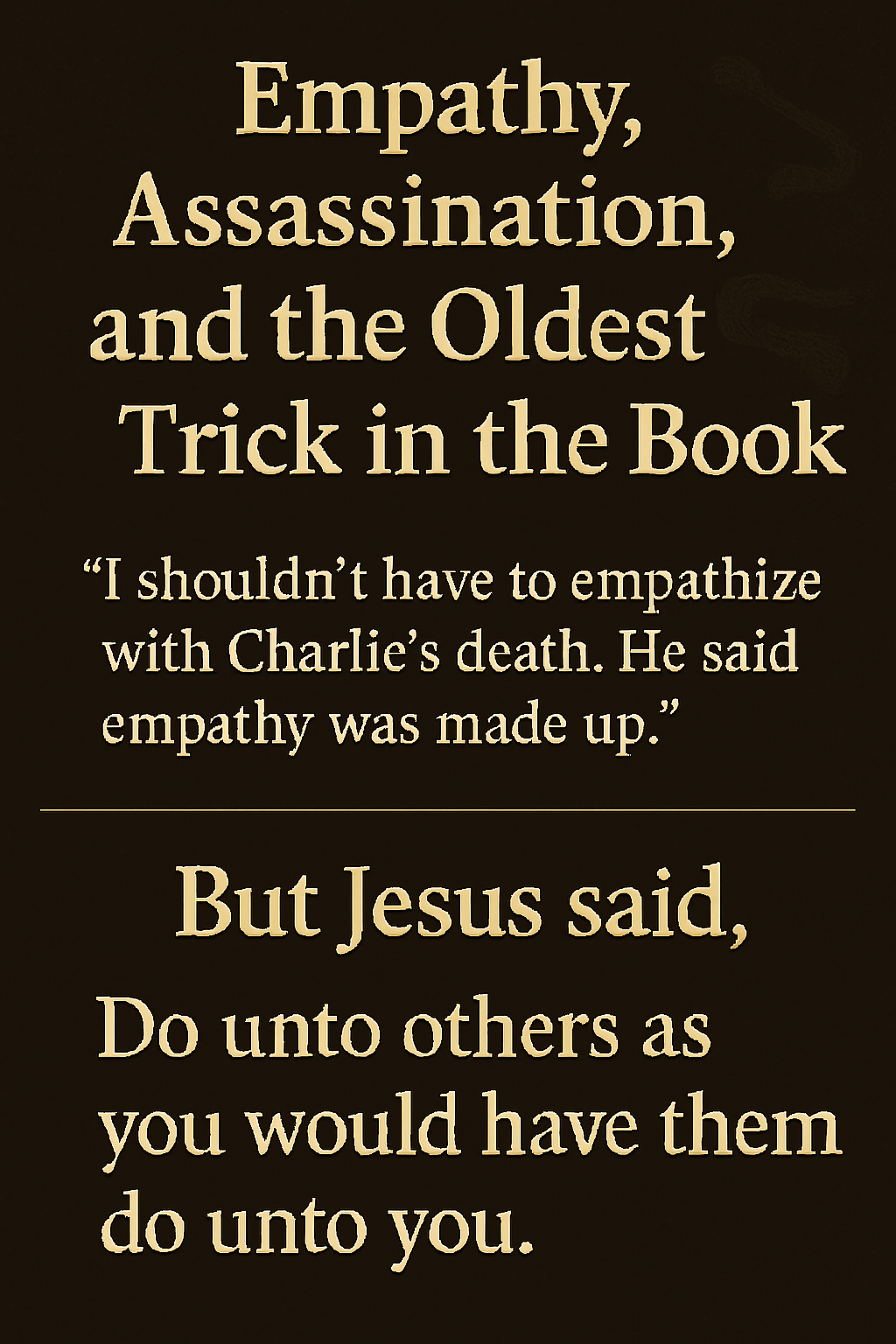
In the wake of Charlie Kirk’s assassination, the public response has been anything but unified or unifying. Some voices have expressed a startling lack of empathy, citing Charlie’s own controversial claim that empathy is a “made-up concept.” For them, his death is not a tragedy but a kind of cosmic irony. If he didn’t believe in empathy, why should anyone extend it to him?
But this line of thinking reveals something deeper—and darker—about our cultural moment. It’s not just about Charlie. It’s about how we treat those we disagree with. How we justify cruelty by pointing to someone else’s perceived moral failure. And how we’ve come to believe that empathy is conditional, transactional, or even optional.
Have we forgotten what Jesus taught about empathy
Contrast that with the teachings of Jesus, who offered a radically different framework. “Do unto others as you would have them do unto you” (Luke 6:31, NIV).
Not “as they deserve.” Not “as they did to you.” But as you would want to be treated. It’s a call to transcend retaliation, to reject the logic of vengeance. “You have heard it said, ‘An eye for an eye,’ but I tell you…turn the other cheek” (Matthew 5:38-39, NIV).
This isn’t weakness. It’s moral courage. It’s having and using the strength to resist the gravitational pull of hatred and division.
Empathy unifies, hatred divides
Division, of course, is the oldest trick in the book. Literally. In Genesis 3, the serpent doesn’t attack Eve with brute force. He divides. He sows doubt. He isolates her from trust in God and from unity with Adam. The strategy of divide and conquer has been used ever since—by empires, ideologies, and yes, even algorithms.
When we justify cruelty because someone “deserved it,” we play into that ancient strategy. We let division win. We let empathy die—not just for Charlie, but for ourselves.
I don’t agree with Charlie Kirk’s thoughts on empathy. Empathy was around long before the radical left claimed anyone on the other side of the political spectrum doesn’t have it.
Empathy does exist. Every time we step out of ourselves and try to enter into another’s experience, we give birth to a form of empathy.
Empathy is about respect
Maybe we won’t ever perfectly feel what another person feels, exactly how they feel it, but we can acknowledge their pain and suffering. We can acknowledge they have a right to feel their feelings, even if we don’t understand them.
Empathy isn’t about unconditional agreement. It’s about respecting another human as a being made in the image of God. As worthy of love. If we lose sight of that, we risk becoming the very thing we claim to oppose.
No man is an island,
Entire of itself.
Each is a piece of the continent,
A part of the main.…
Each man’s death diminishes me,
For I am involved in mankind.
Therefore, send not to know
For whom the bell tolls,
It tolls for thee.“For Whom the Bell Tolls,” by John Donne
(in the public domain)
Leave a Reply