
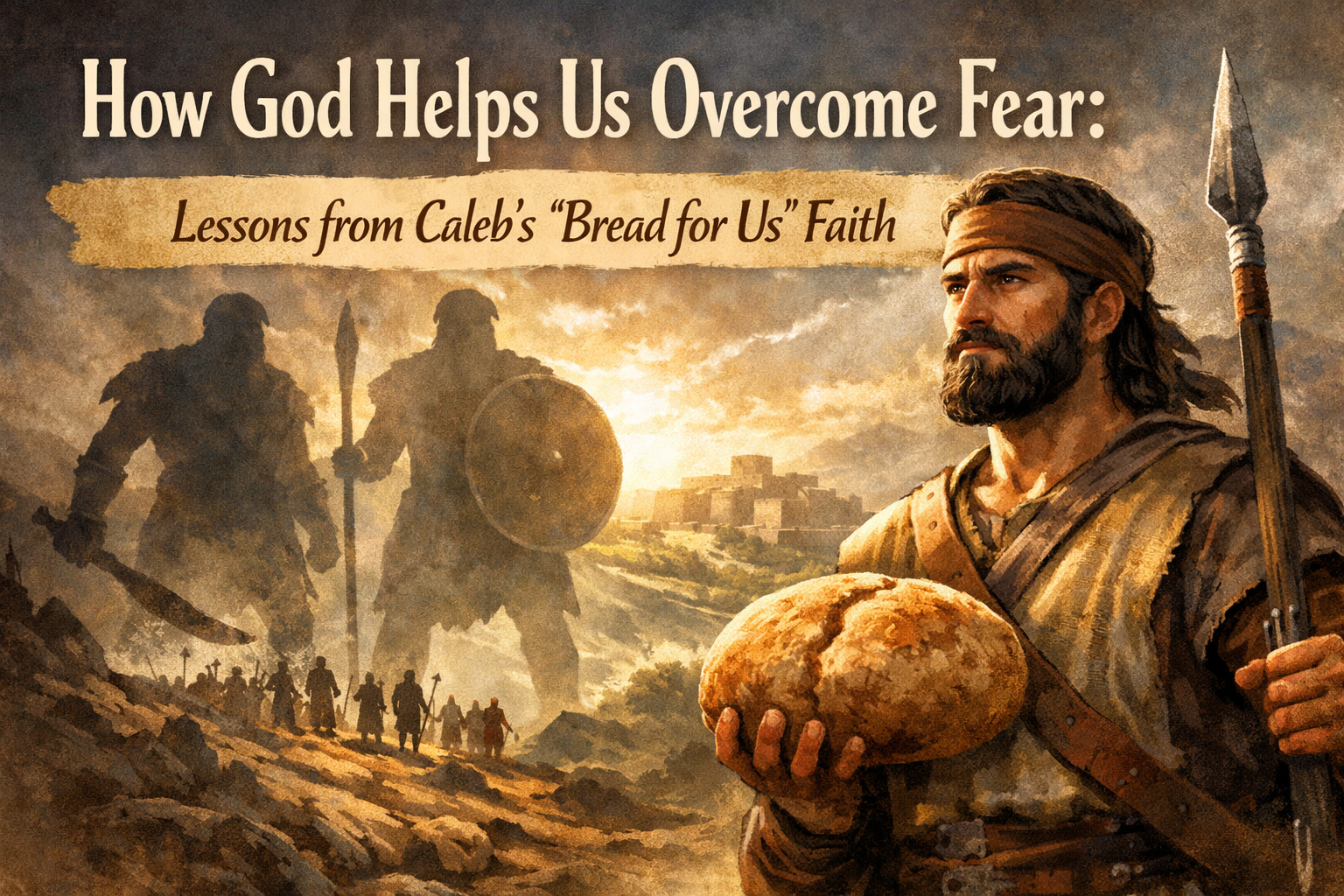

This post explores Caleb’s phrase “they are bread for us” in Numbers 14:9, tracing the biblical imagery of devouring enemies and showing how faith transforms our perception of fear and spiritual obstacles.
“Only do not rebel against the Lord. And do not fear the people of the land, for they are bread for us. Their protection is removed from them, and the Lord is with us; do not fear them.” — Numbers 14:9, ESV
Every now and then, a familiar passage hits with unexpected force. That happened the other day when I was reading the Bible. I paused over Caleb’s bold declaration:
“They are bread for us.”
Bread. Not giants, threats, or obstacles. Bread.
It’s such an odd phrase. Almost jarring in its confidence. The more I sat with it, the more I realized how deeply biblical that imagery runs.
Bread as Victory, Not Sustenance
Caleb wasn’t talking about literal consumption. God wasn’t calling Israel to cannibalism or brutality. This is metaphor. Vivid, visceral, and intentionally provocative. It’s the language of total victory. The kind of triumph so complete the enemy becomes as powerless as food on a plate.
Scripture uses this imagery more than we might expect.
Devouring as a Picture of Overwhelming Power
“God brings him out of Egypt and is for him like the horns of the wild ox; he shall eat up the nations, his adversaries…” — Numbers 24:8, ESV
“You crushed the heads of Leviathan; you gave him as food for the creatures of the wilderness.” — Psalm 74:14, ESV
“Have they no knowledge, all the evildoers who eat up my people as they eat bread…?” — Psalm 14:4, ESV
In each of these passages, “eating” is a metaphor for dominance. One side is so strong and the other so weak that the outcome is as predictable as a predator catching prey.
It’s the image of a cat with a mouse. Swift. Decisive. Unchallenged.
That’s the kind of victory God was promising Israel.

The Tragedy of a Missed Opportunity for Biblical Courage
The people of Israel saw giants. Caleb and Joshua saw bread.
Most of Israel saw only fortified, impenetrable cities. Caleb and Joshua saw enemies already stripped of protection.
The Israelites saw themselves as grasshoppers. Caleb and Joshua saw themselves as children of the God who crushes Leviathan.
The difference wasn’t in the landscape. It was in the lens.
Caleb and Joshua were the only ones who factored God into the equation. The only ones who believed that if God promised them possession of the land, the size of the giants was irrelevant. They were the only ones who understood that the outcome of the battle was already decided.
That’s why they were the only ones of their generation who entered the land.
Faith Over Fear: Turning Giants Into Bread
Fear magnifies the enemy. Faith magnifies God.
Fear says, “We can’t.” Faith says, “God already has.”
Fear sees the problem. Faith sees the promise.
Israel’s failure wasn’t military weakness. It was spiritual rebellion. God had already declared victory. Their refusal to believe Him was the real defeat.
Caleb’s words remind us that the giants we face—circumstances, fears, sins, and uncertainties—are not meant to devour us. In God’s hands, they become nourishment. Growth. Strength. Bread.
The God Who Helps You Overcome Spiritual Obstacles
When God fights for His people, the very things that once terrified them become the means of their strengthening. Obstacles become steppingstones. Battles become stories of God’s faithfulness.
Caleb’s assertion wasn’t dramatic. It was accurate.
He saw reality as defined by God.
And maybe that’s our invitation today–to stop looking at our giants through the lens of fear and start seeing them through the lens of God’s power.
With Him, the things that loom large over us are already defeated. Their protection is gone. They no longer have any power. Their end is inevitable.
In Christ, every enemy—sin, death, fear, and darkness—has already been crushed. And the victory He won becomes the nourishment that strengthens us.
They are bread for us. It’s a strange phrase, but a beautiful promise. What a God!
FAQs: Understanding “They Are Bread for Us” and Facing Giants with Faith
What does the phrase “They are bread for us” mean in Numbers 14:9?
Caleb uses this metaphor to express absolute confidence in God’s power. Calling Israel’s enemies “bread” means he sees them not as threats but as already‑defeated obstacles—something God will use to strengthen His people rather than destroy them.
Is the Bible promoting violence with this “devouring” imagery?
No. The language is symbolic, not literal. Throughout Scripture, “eating” or “devouring” enemies is a metaphor for decisive victory. It emphasizes God’s strength, not human brutality.
Why did Caleb and Joshua see the giants differently from the rest of Israel?
They factored God into the equation. While the rest of Israel focused on the size of the giants, Caleb and Joshua focused on the size of God. Their faith allowed them to see the same situation through a completely different lens—one of victory instead of fear.
Why were Caleb and Joshua the only ones allowed to enter the Promised Land?
Because they trusted God when everyone else rebelled in fear. Their faith aligned with God’s promise, and their obedience positioned them to receive what the others rejected.
How does this passage help Christians face fear today?
It reminds us that challenges, fears, and spiritual battles are not meant to overwhelm us. In God’s hands, they become opportunities for growth—“bread” that nourishes our faith. When we trust God’s promises, our giants lose their power.
Leave a Reply