

Many thanks to Sypher Studios for providing a sample of the product for this review. Opinions are 100% my own.
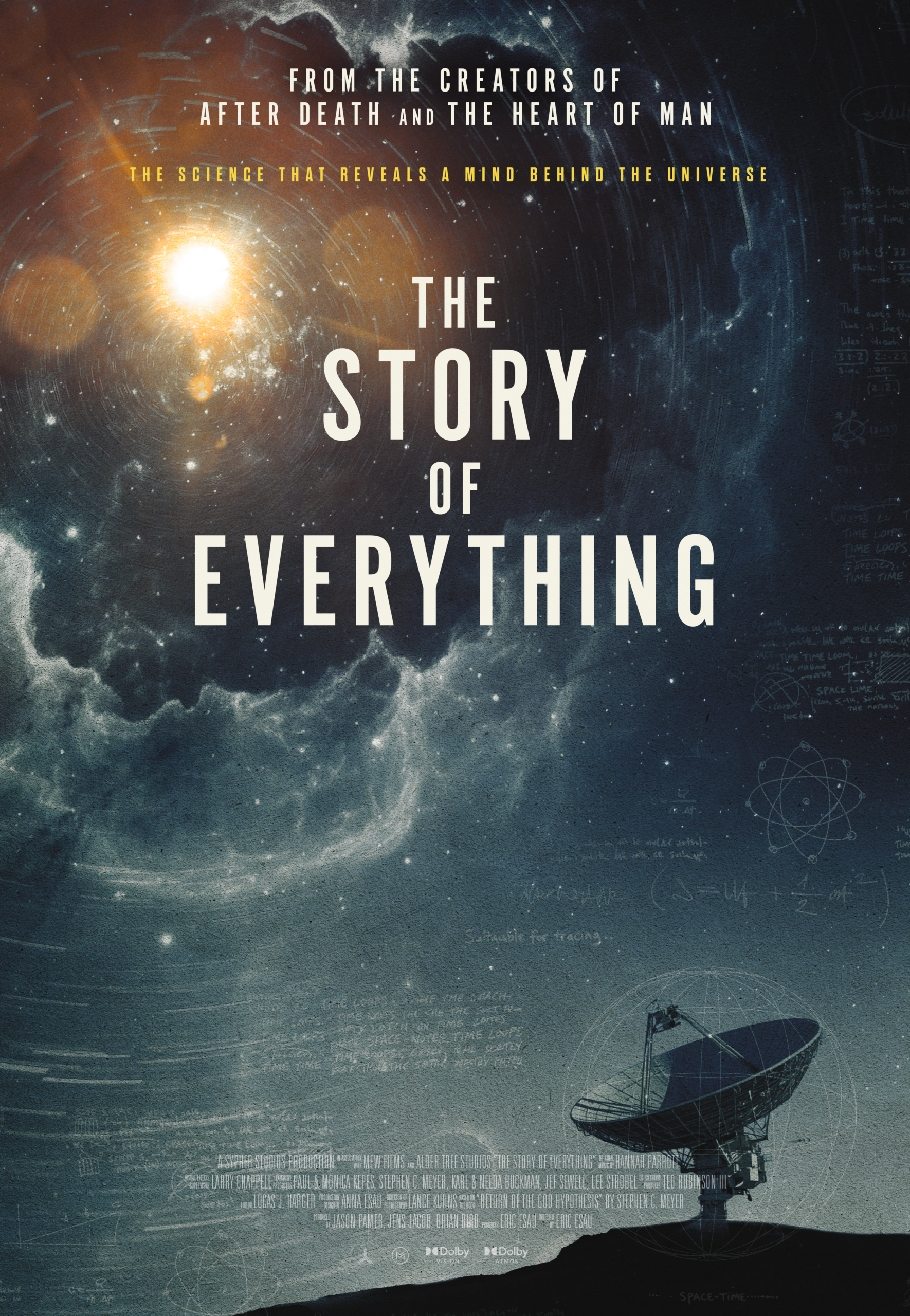
If you’re someone who lights up at the intersection of faith and science — the kind of person who can lose an afternoon watching cosmology videos or who still feels a thrill when hearing the names Galileo, Kepler, or Newton — The Story of Everything is a documentary you’ll want to add to your watchlist immediately.
After a successful nationwide theatrical run that sparked conversation across faith, science, and culture, The Story of Everything is now available to purchase on Amazon Prime Video.
And honestly? It’s fascinating.
A Cinematic Exploration of the Cosmos
Inspired by Stephen C. Meyer’s bestselling book Return of the God Hypothesis, the film asks one of humanity’s oldest and most consequential questions:
Does the evidence point to a universe shaped by blind chance — or by purpose and design?
From the opening scenes, the documentary sweeps you into a visually stunning journey through the laws of physics, the structure of the universe, and the microscopic world of DNA. It’s not just a science documentary. It’s a meditation on meaning.
The official synopsis describes it this way:
“From the precise laws that govern the stars to the intricate patterns found in every living cell, the film traces evidence of intentional design throughout nature.”
And that’s exactly what it does.
Two Competing Stories of Reality
One of the most compelling threads in the film is the contrast between two worldviews:
- The universe is eternal, self-existent, and the product of unguided processes.
- The universe had a beginning — and beginnings require causes.
The film walks through the history of scientific discovery, showing how many of the great scientific minds — Galileo, Kepler, and Newton — believed the universe was intelligible because it was crafted by an intelligent Designer.
Then it moves into the modern era, highlighting voices like Richard Dawkins and Carl Sagan, who argued that science freed us from the impulse to see a Creator behind the cosmos.
But the evidence, the film suggests, has been moving in the opposite direction.
The Universe Had a Beginning — And That Changes Everything
The documentary does a fantastic job explaining the discoveries that pointed toward a cosmic beginning:
- Slipher’s redshift
- Hubble’s expanding universe
- Einstein’s general relativity
- Lemaître’s Big Bang theory
- Cosmic background radiation
Each discovery chipped away at the idea of an eternal universe and pointed toward a moment of origin — a singularity outside space and time.
And if the universe began to exist, then whatever caused it must be:
- outside space
- outside time
- immaterial
- powerful
- intentional
In other words: a Conscious Mind.
Fine-Tuning: The Universe Is “Just So”
This was one of my favorite parts of the film.
The documentary dives into the astonishing fine-tuning of the universe — the delicate balance of physical constants that make life possible. Change any one of them even slightly, and the universe collapses into chaos.
Fred Hoyle’s work on carbon formation is highlighted, including the “singing frequency” of carbon that shocked physicists and nudged Hoyle toward belief in design.
The film also touches on:
- entropy and the improbability of our low‑entropy beginning
- the uniqueness of our solar system
- the circumstellar habitable zone
- the multiverse hypothesis (and its philosophical problems)
- simulation theory
No matter how far scientists stretch to avoid the implications, the fine-tuning keeps pointing back to a Conscious Mind behind the creation of the universe.
Life: Information, Complexity, and the Signature of Intelligence
The second half of the documentary shifts from cosmology to biology.
Here, the film explores:
- the flagellar motor
- the specified complexity of DNA
- the cell as an information-processing system
- the limits of unguided chemical evolution
- the work of scientists like David Berlinski and Dean Kenyon
The argument is simple but profound:
Information always comes from a mind. And the simple cell is overflowing with information.
The film doesn’t shy away from the philosophical implications. If the universe is filled with rational structure, beauty, and information, then perhaps — as Aristotle suggested — it is reaching out to us.
A Beautiful, Thought-Provoking Experience
What I appreciated most is that The Story of Everything doesn’t feel like an argument. It feels like an invitation. To wonder, think deeply, and to consider that the beauty woven into the cosmos is not accidental.
By the end, I found myself wanting to pick up Return of the God Hypothesis and dive even deeper into these ideas.

Where to Watch
You can buy The Story of Everything now on Prime Video!
If you’re planning to use the film in a church setting, small group, youth group, or homeschool environment, the creators have also put together a fantastic set of free Church & Homeschool Resources, including discussion guides and educational materials:
Giveaway: Win a $10 Amazon Gift Card!
And, as part of this review campaign, I’m giving away a $10 Amazon gift card to one U.S. winner!
To enter, simply leave a comment on this post sharing:
Which idea, topic, or scientific question from the film interests you most?
Entries must be submitted by 11:59 PM ET on June 25, 2026. I’ll select one commenter at random and submit the winner’s name and email by the required deadline


Leave a Reply