
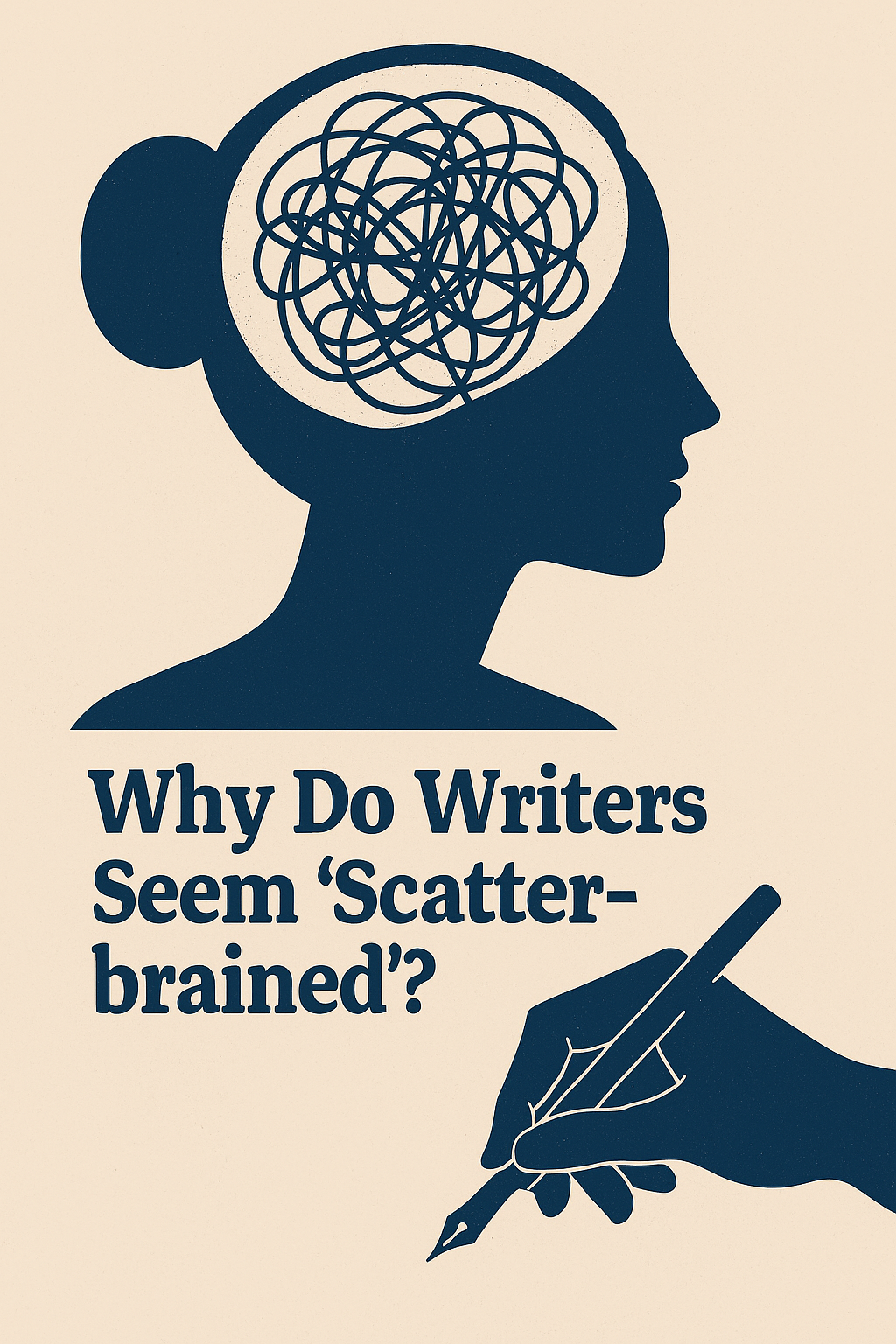

Writers have long carried the reputation of being absent-minded, distracted, or downright scatterbrained. From the eccentric professor stereotype to the dreamy novelist who forgets to eat while chasing a plot twist, culture loves to imagine authors as brilliant but disorganized.
But is that really the truth? And more importantly—what does it mean for those of us who sometimes forget important things, like following up with fellow writers or nurturing our creative community?
The Myth of the Scatterbrained Writer
The stereotype exists for a reason. Writers often juggle multiple storylines, research threads, and character arcs at once. To an outsider, that can look like chaos. Add in the cultural image of the “absent-minded genius,” and it’s easy to see why the label sticks.
Yet many authors are the opposite. Anthony Trollope famously wrote for three hours every morning before heading to his day job at the post office. Stephen King treats writing like clockwork, producing thousands of words daily. Academic writers thrive on structure, deadlines, and meticulous revision.
The truth is: creativity doesn’t require scatterbrained habits. But it does require a brain that makes leaps, associations, and connections—sometimes at the expense of remembering the mundane.
Why Writers Forget Things
If you’ve ever forgotten to email a critique partner back, missed a networking opportunity, or let a brilliant idea slip away, you’re not alone. Forgetfulness in writers often comes down to:
- Cognitive bandwidth: Writing consumes working memory, leaving less space for admin tasks.
- Creative immersion: When you’re deep in a project, the outside world blurs.
- Emotional weight: Reaching out to other writers can feel scary, which makes it easier to postpone.
What looks like “scatterbrained” is often just your brain prioritizing the urgent (finishing a draft) or the protective (avoid human interactions at all costs) over the important (building connections to enhance your writing and personal lives).
Reframing Forgetfulness as a Creative Feature
Neuroscientists like Henning Beck argue that the brain’s so-called “mistakes”—forgetting, distraction, tangents—are actually what make us creative. The same mental quirks that cause you to lose track of an email thread also allow you to connect two unrelated ideas into a fresh metaphor.
In other words: a touch of scatterbrained energy isn’t an irredeemable flaw. It’s part of the creative engine.
Practical Systems for Staying Connected
That said, writers thrive in community. So how do you keep from losing track of your people? Here are a few lightweight systems designed specifically for writer-to-writer connections:
1. The Connection Tracker
Make a simple spreadsheet or doc with three columns: Name, Last Contact, Next Step. Update it weekly. You can download a sample document here.
2. Follow-Up Friday
Pick one day a week to send a quick note, comment on a social media post, or check in with a critique partner. To build a consistent pattern of reaching out, you have to start with the first contact.
3. Micro-Reminders
When you think, “I should message Sarah about her draft,” set a phone reminder for a specific time. Don’t trust memory alone. If it’s not in my phone, I’m not doing it. I’ve learned this from personal experience, much to my chagrin!
4. Gentle Accountability
Pair up with another writer who also wants to stay more connected. Check in weekly and ask, “Did you reach out to anyone this week?”
5. The Scatter Capture Notebook
One of the simplest ways to stay connected is to create what I call a Scatter Capture Notebook. This can be a small paper notebook you keep by your desk or a pinned note on your phone—whatever feels most natural to you.
The idea is straightforward: whenever a name, idea, or follow-up task pops into your head, capture it immediately in this one dedicated place. By giving your thoughts a home, you free your mind from the pressure of remembering everything.
Over time, this notebook becomes a living record of your connections and creative sparks. A quick glance can remind you who to reach out to, what ideas you don’t want to lose, and which opportunities are waiting for a nudge.
The act of writing it down makes it stick—and ensures that your scattered moments of inspiration don’t slip away unnoticed.
A One-Page Dashboard
If spreadsheets feel overwhelming, try a one-page “Connection Dashboard” you can print or pin digitally. On this page, you will write down:
- The top 3 people to reach out to this week
- Upcoming deadlines/events
- People I haven’t checked in with lately
- Quick wins (comments, shares, encouragement)
- Big picture goals (critique circle, collaborations, events)
This keeps your network visible without it becoming another burden. Here’s what my Connection Dashboard looks like.
Key Takeaways and Final Thoughts
- The “scatterbrained author” is more stereotype than reality. Many writers are highly structured and disciplined.
- Forgetfulness often comes from cognitive overload, creative immersion, or emotional weight, not carelessness.
- Neuroscience suggests that distraction and tangents can actually fuel creativity, making forgetfulness an asset, not a flaw.
Writers can stay connected with peers through lightweight systems:
- A simple Connection Tracker
- Weekly rituals like Follow-Up Friday
- Quick micro-reminders on your phone
- An accountability partner
- A Scatter Capture Notebook for noting names and ideas
Not all authors are scatterbrained—but many of us wrestle with forgetfulness, especially when it comes to connecting with others. Instead of seeing this as a flaw, we can recognize it as part of the creative process and build gentle systems to support ourselves.
Because at the end of the day, writing isn’t just about words on the page. It’s about the people who walk alongside us in the journey. And remembering them—intentionally and consistently—might be the most important act of creativity we practice.
Building intentional habits helps transform scattered moments into sustainable creative connections.
Frequently Asked Questions
Are all authors scatterbrained? Not at all. While some writers may appear absent-minded because they juggle multiple ideas at once, many are highly structured and disciplined. The “scatterbrained author” is more of a cultural stereotype than a universal truth.
Why do writers often forget things? Writing consumes a lot of mental energy. When you’re immersed in a project, it’s easy to lose track of emails, meetings, or networking opportunities. Forgetfulness often comes from cognitive overload, not carelessness.
Is forgetfulness a weakness for writers? Not necessarily. Neuroscientists suggest that distraction and tangents are part of what makes humans creative. For writers, occasional forgetfulness can actually be reframed as an asset to the creative process.
How can writers stay connected with other writers? Simple systems can make a big difference:
- Keep a Connection Tracker (spreadsheet or notebook).
- Try a weekly ritual like Follow-Up Friday.
- Use micro-reminders on your phone.
- Partner with an accountability buddy.
- Capture names and ideas in a Scatter Capture Notebook.
What’s the best quick fix if I keep forgetting to follow up? Set a reminder the moment you think of it. Even a 10-second action—like inserting a note in your phone—can prevent a missed opportunity later.
If you’re looking for ways to grow your writing life beyond the page, here’s a resource I trust. Get free reviews for your books, read free craft and business articles, and enter contests and win awards. Just click on the banner below to get started.

Leave a Reply