
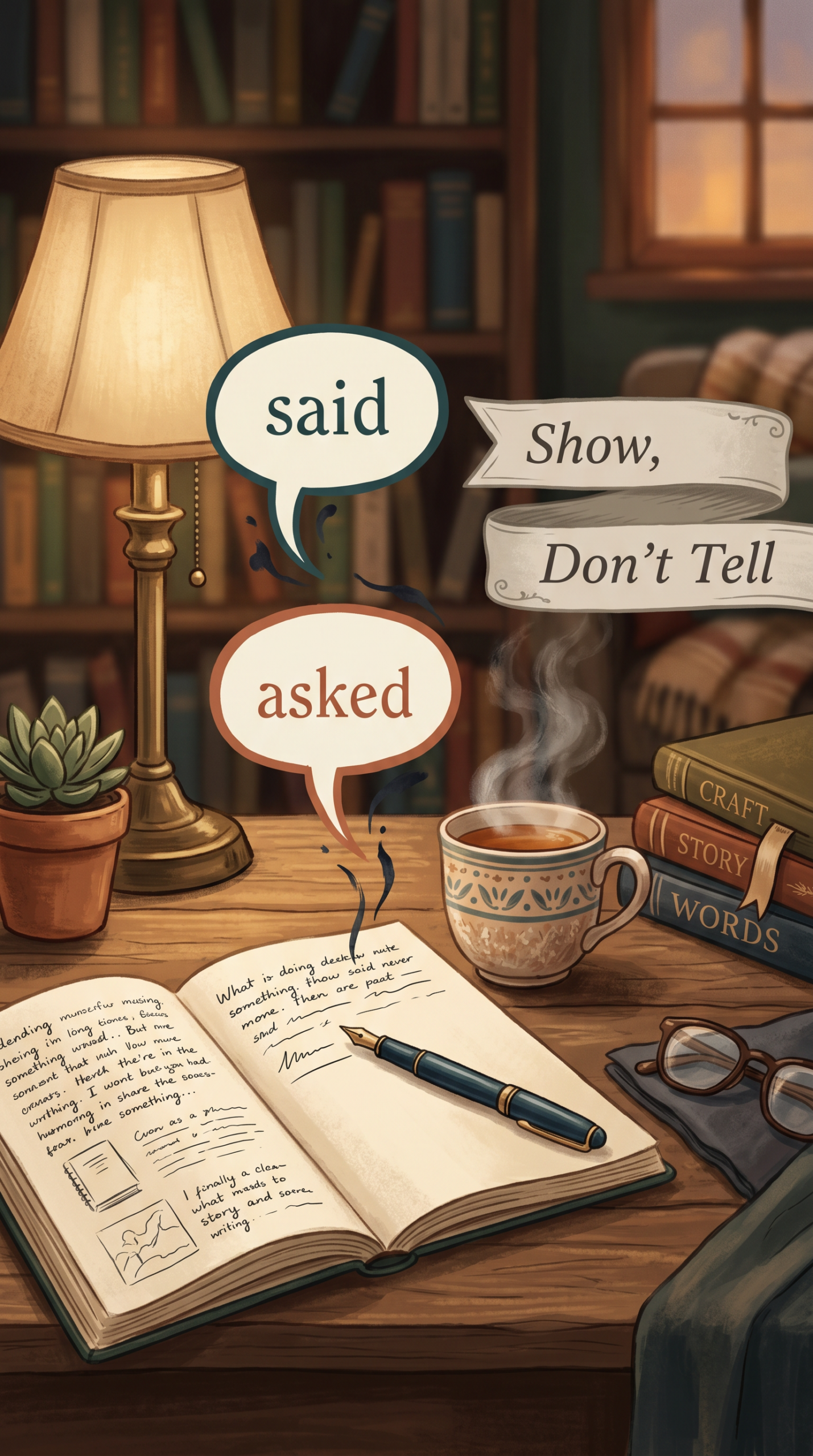

Writers ask me all kinds of questions during the editing process, but one that comes up again and again is this:
“When I do use dialogue tags, can I use them to show emotion?”
It’s a great question, and the answer is both simple and freeing.
The Short Version
Simple tags keep your dialogue clean. Action beats carry your characters’ emotion. Delivery tags (e.g., “whispered,” “shouted,” or “murmured”) are fine in moderation.
That’s it. Truly.
The Longer Version (for the writing craft nerds among us)
Dialogue tags have one job – to identify who’s speaking. That’s why the simplest tags — “said” and “asked” — are still the gold standard. They’re invisible. They don’t pull the reader out of the moment.
But sometimes you want to show how something is said. That’s where delivery tags come in:
- whispered – “Don’t wake the baby,” she whispered, leaning in, her breath warming his ear.
- murmured – “It’s going to be all right,” he murmured. His thumb traced slow circles across her knuckles.
- shouted – “Get out of the road!” she shouted, sprinting toward him as the truck rounded the corner.
- called – “Dinner’s ready!” he called from the kitchen, hoping she could hear him over the music upstairs.
- muttered – “This is exactly what I was afraid of,” she muttered, shoving the drawer closed with her hip.
Since these describe volume or tone, not emotion, they’re perfectly fine … as long as you use them sparingly.
Writers get into trouble is with emotional tags:
- “she said angrily”
- “he said lovingly”
- “she said sadly”
These aren’t wrong, but they’re almost always weaker than letting the emotion show up in action, body language, or internal thought.
For example:
“I’m fine,” she said angrily.
versus
“I’m fine.” She shoved the drawer closed with unnecessary force.
The second one shows the anger instead of labeling it. The reader feels it instead of just hearing the narrator’s perspective of it. This is the heart of the old “show, don’t tell” rule — not because telling is bad, but because showing immerses your reader in your story.
A Resource I Recommend Constantly
If you ever find yourself thinking, Okay, but what does “anxious” look like? What does “hopeful” look like?, then you need The Emotion Thesaurus in your life.

I bought the Kindle version and have it open on Amazon’s cloud reader when I write so I can search for whatever emotion I need whenever I need it. This book is one of the most practical craft tools out there.
Final Thoughts
Dialogue tags aren’t the place to carry emotional weight. That’s what your characters’ bodies, thoughts, and choices are for. Keep the tags simple, let the beats do the heavy lifting, and your scenes will feel more alive and authentic.
And if you ever want help fine‑tuning a scene or choosing between a tag and a beat, I’m always happy to take a look. Comment here, message me on Facebook, or shoot me an email.
FAQs
What are dialogue tags?
Dialogue tags are the words that identify who is speaking in a line of dialogue (for example: “she said,” “he whispered,” or “they shouted”). They help readers follow conversations without interrupting the flow of the story.
When should I use delivery tags like “whispered” or “shouted”?
Use delivery tags when the volume, tone, or urgency of the dialogue matters to the scene. Tags like “whispered,” “murmured,” or “shouted” add emotional context without needing extra description.
Are action beats better than dialogue tags?
Action beats often feel more natural because they show what the character is doing while speaking. For example: She rubbed her temples. “I can’t keep doing this.” Beats can replace tags entirely, but both tools work well when used intentionally.
How do I avoid overusing dialogue tags?
Keep tags simple and unobtrusive. Most of the time, “said” and “asked” are enough. Use stronger delivery tags sparingly, and rely on action beats or emotional cues to carry the weight of the scene.
What’s the difference between showing and telling in dialogue?
“Telling” states the emotion directly (“she said angrily”). “Showing” reveals emotion through action, body language, or subtext (She slammed the cupboard door. “Fine.”). Showing creates a more immersive experience for your reader.
Can I mix dialogue tags and action beats?
Yes, mixing them adds rhythm and variety. Just avoid stacking them unnecessarily (e.g., “Here, I think you need this,” she whispered softly, her voice barely audible, as she leaned in). Choose one strong movement or tone indicator, and let it stand.
How do I make dialogue sound more natural?
Read it aloud, remove filler words, and let your characters respond with emotion, not explanations. Natural dialogue often includes interruptions, pauses, and subtext.
Common Mistakes Writers Make with Dialogue Tags
Using “fancy” tags when “said” works better
Many writers overuse dramatic tags like “exclaimed,” “retorted,” “interjected,” or “intoned.” These draw attention to themselves and pull readers out of the moment.
Better: Use said or asked most of the time, and let the emotion come from the dialogue or action beat.
Stacking tags and adverbs together
Example:
“I’m fine,” she said angrily.
If the emotion is already clear from the scene, the adverb becomes redundant.
Better: She slammed the cupboard door. “I’m fine.”
Using delivery tags that contradict the dialogue
Example:
“I SAID I’M CALM!” he whispered.
Delivery tags must match the tone, volume, and emotional intent of the line. If the dialogue is loud, the tag should be loud.
Using tags that don’t fit the sound
“Hissed” requires an s‑sound. You can’t hiss:
“No!”
But you can hiss:
“Stop this nonsense.”
Overusing “murmured,” “muttered,” and “whispered”
These tags are effective when used sparingly, but too many soft‑spoken tags make characters sound like they’re mumbling through the entire book. Use them when the moment calls for it, not as a default.
Using tags to explain emotion instead of showing it
Example:
“I don’t care,” she said sadly.
This tells the reader how she feels instead of showing it.
Better: She stared at the floor. “I don’t care.”
Repeating the same tag too often
If every line is “said,” the rhythm becomes flat. If every line is “whispered,” the scene becomes unintentionally comedic. Mix in action beats, body language, and silence to create variety.
Putting the tag in the wrong place
Example:
“If you leave,” she said, “I’ll never forgive you.”
This is correct. But many writers accidentally break the sentence in unnatural places:
“If you,” she said, “leave, I’ll never forgive you.”
Keep the interruption where it feels natural to how people actually pause in their speech.
Leave a Reply