

Joel 2:12–13 (NIV) is a call to repentance that pulses with urgency and tenderness:
“Even now,” declares the Lord, “return to me with all your heart, with fasting and weeping and mourning.” Rend your heart and not your garments. Return to the Lord your God, for he is gracious and compassionate, slow to anger and abounding in love, and he relents from sending calamity.”
The Hebrew phrase translated as “slow to anger” is literally “long of nose.” It’s a strange image in English—almost comical—but in Hebrew, it’s deeply symbolic. A long nose means a long fuse. It takes time for anger to kindle. God’s nose is long because His mercy is wide.
Pinocchio’s Nose vs. God’s
In our cultural imagination, a long nose often signals deceit. Pinocchio’s nose grows with every lie—a visible mark of wrongdoing. It’s a punishment. A sign of shame and a megaphone to the world that something is broken inside.
But God’s long nose is the opposite. It’s not a consequence of sin. It’s a shield against it. His long nose means He doesn’t lash out. He waits. Listens. Gives space for repentance. Pinocchio’s nose exposes guilt, but God’s nose covers it with grace.
Rend Your Heart, Not Your Garments
The prophet Joel urges us to tear our hearts, not our clothes. External displays of grief mean little if the heart remains untouched. God’s patience isn’t permission to delay. It’s an invitation to go deeper. To stop performing repentance and start living it.
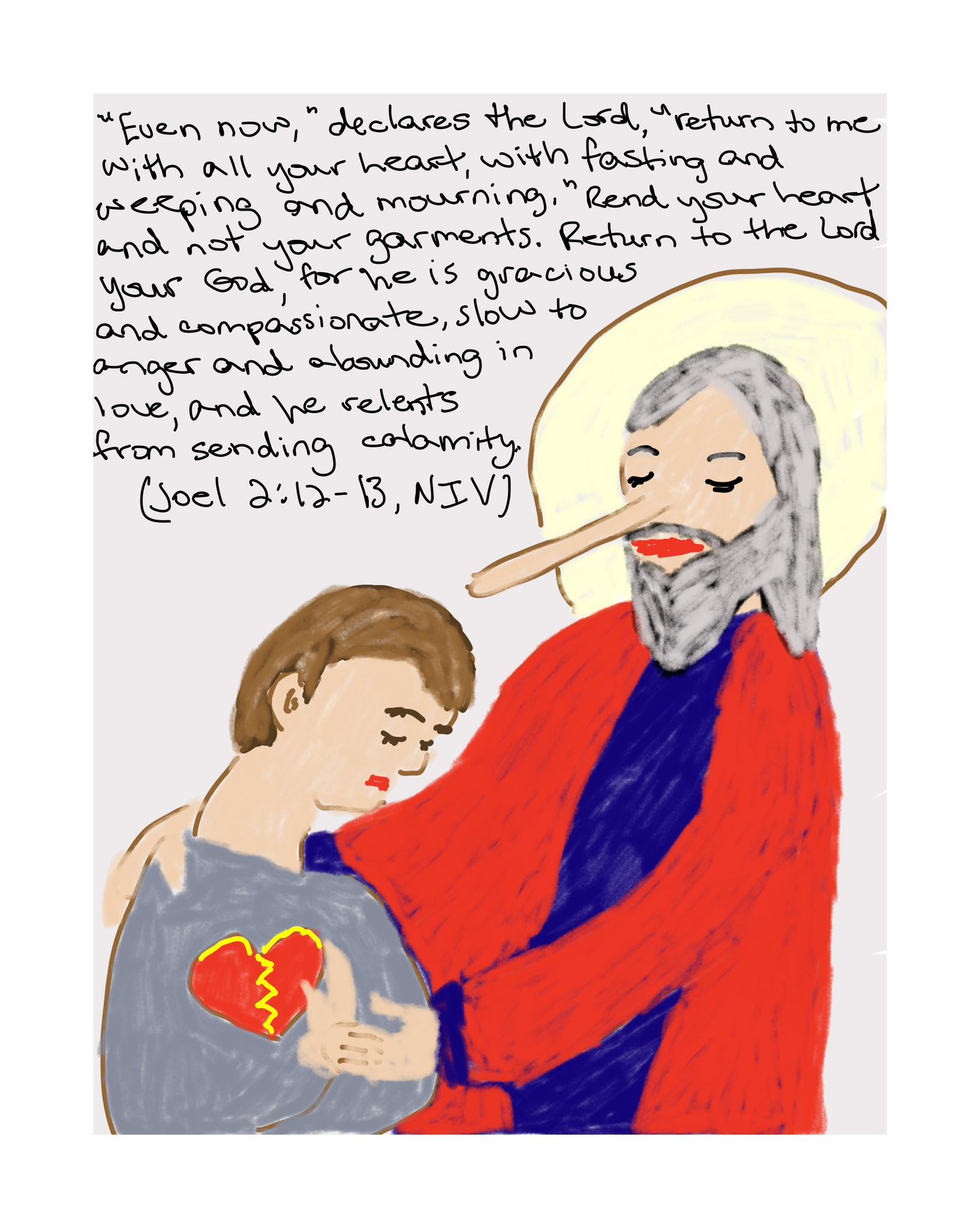
The image of a broken heart held in trembling hands—glowing, jagged, and vulnerable—is a powerful visual of true contrition. It’s not polished or performative. It’s raw and radiant. And exactly what God longs to receive.
The Divine Embrace
In the image I drew to go along with my reflection on this verse, the penitent’s broken heart glows in his hands. With a long nose, a visual metaphor for His divine patience, God’s touch on the weary soul is tender, not condemning. This is the God of Joel 2: gracious, compassionate, slow to anger, and abounding in love.
The halo around His head isn’t just a symbol of holiness. It’s a beacon of hope. The light doesn’t expose the sinner’s shame. It illuminates the path back home.
Even Now
The phrase “even now” is a lifeline. It means it’s not too late. No matter how far we’ve wandered and no matter how many lies we’ve told or truths we’ve avoided, God’s nose is still long. His anger is still slow. His love is still abounding.
We don’t return to a God who’s tapping His foot in frustration. We return to a God who’s waiting with open arms and a heart full of compassion.
So let’s rend our hearts. Let’s hold them out, jagged and glowing. And let’s trust that the long nose of mercy will meet us there. Not with wrath, but with grace.
Key Takeaways
- “Slow to anger” in Hebrew literally means “long of nose”—a symbol of divine patience.
- Pinocchio’s nose grows from deceit; God’s nose stretches from mercy.
- True repentance is internal—“rend your heart, not your garments.”
- God’s compassion is active, not passive. He relents from sending calamity.
- “Even now” means it’s never too late to return.
Let this be the season of return. Not with fear, but with faith. Not with shame, but with surrender. The One who has the long nose of mercy is waiting.
FAQs: Slow to Anger — God’s Long Nose of Mercy
What does “slow to anger” mean in Hebrew?
The phrase comes from the Hebrew idiom ’erek appayim, which literally means “long of nose.” In Hebrew imagery, a “long nose” represents patience — the idea that God’s anger takes a long time to “heat up.” It’s a metaphor for His steady, compassionate restraint.
Why does “long nose” symbolize patience?
Ancient Hebrew used physical, body-centric imagery to describe emotional states. A flaring nose signaled anger. A long nose signaled the opposite — a slow, measured response. It’s a way of saying God does not rush toward judgment but gives space for repentance.
Where does the Bible describe God as slow to anger?
This description appears repeatedly throughout the Bible, including Exodus 34:6, Numbers 14:18, Psalm 86:15, Jonah 4:2, and Joel 2:13, and 2 Peter 3:9 — forming one of Scripture’s most consistent portraits of God’s character.
Does God’s patience mean He never gets angry?
No. Scripture shows that God does become angry. But His anger is always righteous, measured, and purposeful. “Slow to anger” means His mercy leads, His compassion dominates, and His judgment is never impulsive.
How does this truth shape our spiritual lives?
Knowing God is slow to anger invites us to return to Him without fear. His patience gives us room to repent, heal, and grow — and it models the kind of mercy we’re called to extend to others.
Leave a Reply