

Healing rarely announces itself. It doesn’t knock politely or wait until you have margin to deal. It doesn’t ask whether you’re ready, rested, or emotionally prepared. Healing often begins in the moments when life cracks open, whether gently or violently, and something you didn’t even know was still there rises to the surface.
I didn’t expect to run headlong into my healing journey at a cemetery on a hot June morning. I didn’t expect it to involve paperwork errors, a confrontation, or the kind of emotional unraveling that leaves you breathless. I didn’t expect a sweet writer friend to become a witness to my meltdown, or my husband to have to postpone a road trip to Massachusetts to come stand beside me in a moment that felt both holy and humiliating.
But healing rarely looks like what we imagine. And, sometimes, the most sacred work God does in us begins in places we would never choose.
This is the story that anchors my healing pillar — not because it is dramatic, but because it is honest. Human. The kind of moment that reveals what healing really is – a slow, surprising, God-held process of becoming whole again.
The Morning Everything Broke Open
It had been five months since my dad passed away. Five months of paperwork, phone calls, arrangements, and the strange numbness that follows loss. Five months of trying to be strong and responsible. Of trying to hold everything together because that’s what I’ve always done.
I thought I was doing “well enough.” Managing. I thought the hardest part was behind me. But grief has its own timeline.
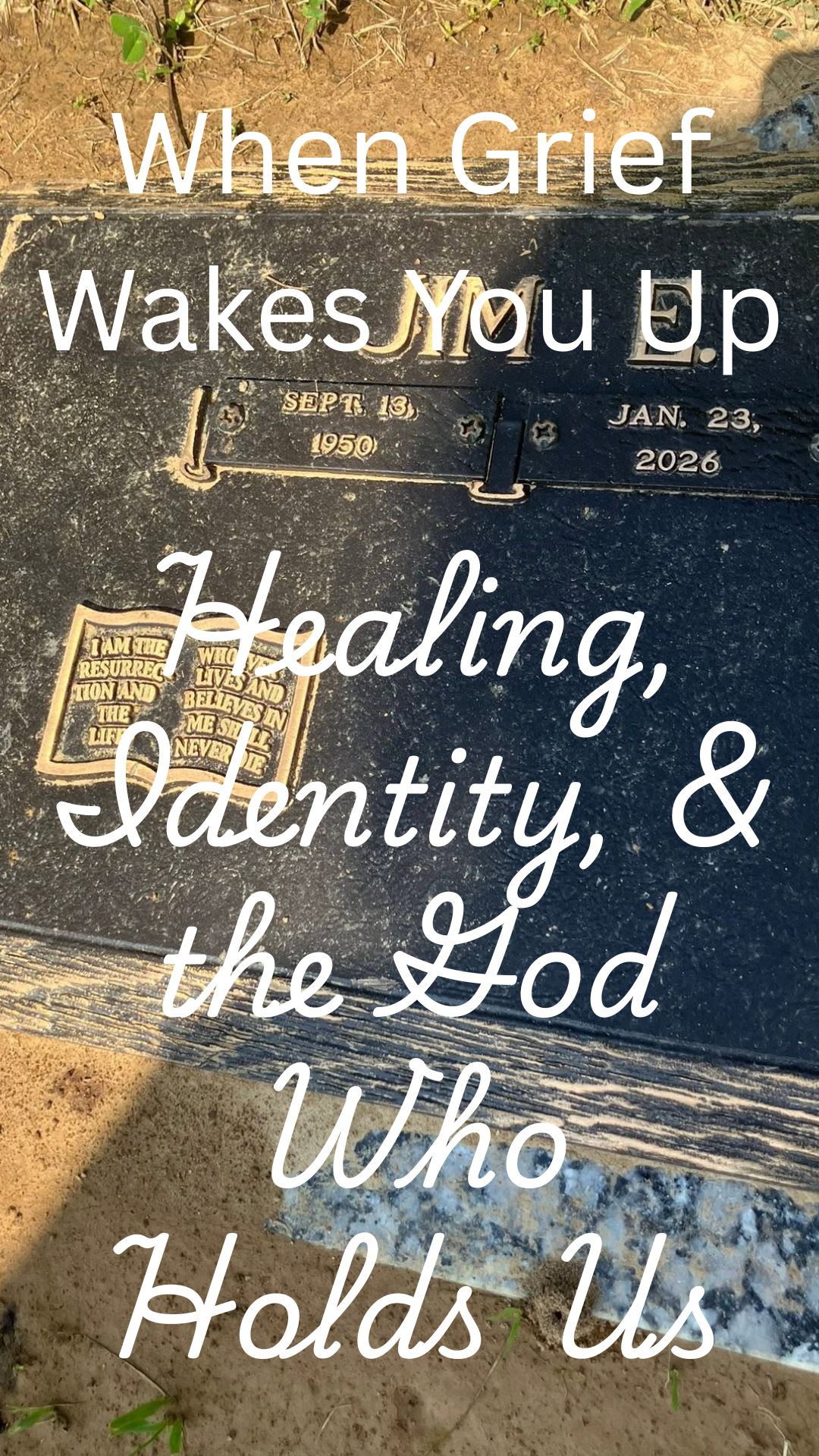
My friend was in town for a brief visit and asked if I would take her to the cemetery to visit her parents’ grave. It’s the same cemetery where my parents are buried, so of course I agreed. And, of course, I wanted to visit my parents, as well. As we headed toward my parents’ cemetery plot, I was looking forward to a quiet moment. Nothing dramatic or especially heavy. Just a simple check to see whether Dad’s death date plate had finally been installed correctly. I had visited at least once a month during the five months after he died. Each time, something was wrong.
At first, there wasn’t enough dirt covering their grave. After multiple phone calls and follow-up visits to try to correct it, I finally threatened to bring in a wheelbarrow and shovel and put the dirt on myself. Only then did the grave get properly covered.
I tried to be more patient with the marker plate. These things take time. But I still checked in with the office regularly to see if there was any news. To see whether progress was being made. I still followed up and carried the responsibility of making sure my parents’ resting place was cared for. And, on that day, when I saw the plate finally in place, my heart soared. It was done. All was right.
But when I walked up to the marker to get a closer look, my stomach dropped. The date was wrong. This wasn’t over. Not by a long shot.
Something inside me shifted. Suddenly, I wasn’t the responsible daughter managing logistics. I wasn’t the adult who could handle anything. I wasn’t the woman who had spent her whole life being strong and carrying the weight of everyone else’s baggage on her back like a faithful pack mule.
In that moment, I was a grieving child without her daddy. And I wasn’t able to fix anything for him anymore. I couldn’t even fix this one thing.
The Confrontation
I pulled my cell phone out of my pocket and pressed my husband’s emergency contact. He answered on the second ring.
“They got Dad’s death date plate on the marker, but the date is wrong. They have it as the twenty-third, not the twenty-second. He didn’t die on the twenty-third. That’s Amanda’s birthday. He was not going to die on her birthday.”
He sighed. “Stay there. I’m on my way.”
I turned to my friend. “We’re going to take a little trip to the office to talk to some people.” Even though, just minutes before, I had been fuming with anger, I laughed to try to dispel the tense situation.
My friend smiled and shook her head. “You’re amazing. The only person I know who can laugh when they’re angry.”
I grinned, even as my chest cracked open inside ne. Defusing through laughter had always been my go-to. I was the peacekeeper. The one expected to be happy and charming no matter what fires were burning things down around me. Only now am I beginning to recognize that laughter isn’t just a habit. It can be a trauma response.
Once inside the office, though, I stopped laughing. I explained to the man that the date was wrong, and how I knew it. “I was there when he died. It was around seven o’clock in the evening on the twenty-second. It wasn’t the twenty-third. I was there. I know.”
The man stretched his arms out across his desk. “Well, I wasn’t there. I have to go by the paperwork.”
In hindsight, I don’t think he meant to be unkind. But in the moment, his words hit me like a slap in the face. The heat, the humidity, the emotional strain – all of it had been building inside me for half an hour. But since I knew I would probably go to jail if I hit the man sitting behind the desk, I punched the nearest doorframe instead.
My husband took over the conversation. Calm, steady, and protective. Saying what I couldn’t say. Not raising his voice or escalating. Just making it clear that this mattered. That we expected it to be corrected. We weren’t going to be dismissed so easily.
His presence grounded me, and his support steadied me in a way I desperately needed. I was stuck in the trauma cycle. Especially since the man kept talking about his paperwork. I began to fear what would happen if he refused to admit that his paperwork was wrong.
I felt small, unheard, and powerless. Because I’ve met plenty of people like that before, including my parents, who ignored the truth of my lived experiences in favor of whatever “evidence” made their lives easier.
The man at the cemetery wouldn’t even let us bring in a death certificate to show him. He wanted to call the funeral home to see whose fault this mistake was. But he did promise to call and let us know what he found out.
I wasn’t going to hold my breath.
The Dog Who Knew Before I Did
After my husband and I took my friend out to lunch, he continued on to Massachusetts. I took my friend back to her cousin’s house and headed home. That was where the dam broke.
I felt the tears rising before I could stop them. Not polite or quiet. The kind of tears that come from the deepest part of you — the part that has been holding everything in for too long.
That was when my Australian Shepherd came to me.
She wasn’t originally supposed to be my dog. My mother had begged for a dog. Insisted she needed one. Insisted she would take care of her. I knew it was a bad idea. My parents could barely take care of themselves. But my father took us all to the humane society anyway. And the dog walked straight to me.
I walked her every day. Not long after we brought her home, she started spending the night at my house. Six months later, she and my mother moved in with me. Seven months after that, my mother was gone.
So, yes. She was supposed to be their dog. But she became mine. She became family. She became witness to every hard thing that followed.
She has always been sensitive to my emotions, but this moment was different. She walked straight to me, pressed her body against my legs, and looked up with eyes that said, I’m here.
Not curious. Not needy. Just present. Steady. Attuned.
And something in me broke open even further. Not in panic this time, but in recognition. Because she wasn’t just comforting me. She was reminding me of everything I had carried. Everything I had inherited. Everything I had survived.
She was reminding me of the years I spent caring for my parents. Holding everything together. Being the one who kept everyone else afloat. The emotional buffer. The peacekeeper. The one who absorbed the chaos, so no one else had to.
My dog was pointing me to the truth I didn’t want to face. I had been carrying the brunt of my grief alone, and I didn’t know how to stop. Her presence grounded me in a way nothing else could. She stayed pressed against me until my breathing slowed, my hands stopped shaking, and I could feel my feet on the ground again.
She was speaking without words, but my body heard her loud and clear. You’re not alone in this. Not anymore.
When God Meets You in the Breaking
My dog wasn’t the only one there with me at the time. My God was there too.
I ignored Him in the panic. I couldn’t hear Him in the moment when everything inside me collapsed. I didn’t feel Him in the confrontation, but I felt Him afterward.
I felt Him in the quiet. In my husband’s hug. In the way my dog jumped up in my lap and leaned her whole weight against me. I felt God in the way my breath slowly returned and my heart softened instead of hardening.
I felt Him in the way the truth began to rise gently inside me. I began to hear His voice, saying:
You don’t have to be strong all the time. You don’t have to carry everything alone. You don’t have to hold your grief together. You don’t have to know who you are right now. You are held. You are loved. You are allowed to heal.
God doesn’t shame us for breaking. He meets us there.
God doesn’t demand composure. He offers comfort.
He doesn’t rush our healing. He walks with us through it.
The Lifelong Caregiver Who Didn’t Know How to Receive Care
I’ve spent my whole life caring for others. Especially my parents. It was part of my identity. My calling. My wiring. Even in the womb, my pancreas put out insulin for my diabetic mother to help control her blood sugar. The doctor had to take me out a month early to try to protect me.
I know how to show up. Anticipate needs. Manage crises. Be strong.
But I don’t know how to fall apart. I don’t know how to ask for help. Let others carry me. Be vulnerable in front of people, especially when they might misunderstand. I don’t know how to let myself be human when I’ve spent decades being the one who held everything together and almost literally kept everyone else alive.
The cemetery confrontation forced me into a moment I couldn’t control. A moment where my strength wasn’t enough. I couldn’t keep my parents alive anymore. They were already dead. Some things cannot be made right no matter how hard you try. And, in that moment when I realized I might not even be able to keep their memory alive accurately, my emotions refused to stay neatly tucked away.
My father’s death, coming less than eight months after my mother’s death, didn’t just take him from me. It took a part of my identity. The role I had played for years. The sense of purpose I had built around caring for him. For both of them.
I had to admit to myself I didn’t know who I was without the role of caregiver. I had to acknowledge that healing isn’t just about recovering from pain. It’s about rediscovering identity.
Healing Is Not a Straight Line
A friend posted this on Facebook a couple of days ago, and as soon as I read the post and saw the image, I knew it belonged here.

Healing is not tidy or linear. It’s definitely not predictable. It doesn’t follow a schedule. It doesn’t care about your to-do list. Nor does it wait until you’re ready.
Healing is a series of moments. Some are small. Others are seismic. But all the moments slowly reshape you.
Sometimes healing looks like quiet reflection or prayer. Sometimes healing looks like therapy, journaling, or reading Scripture. But sometimes healing looks like wigging out in a cemetery because a date is wrong.
Healing is not weakness. Or failure.
Healing is the courage to feel what you’ve been carrying. The willingness to let God touch the places you’ve avoided. The slow, sacred work of becoming whole again.
What This Story Taught Me About Healing
Looking back, I can see that the cemetery moment was a turning point. Not because it was dramatic, but because it was honest. Because it revealed truths I had been avoiding. Because it opened the door to deeper healing.
Here’s what I learned:
1. Healing begins when honesty begins.
You cannot heal what you refuse to feel.
2. Healing is embodied.
Your body often knows what’s going on before your mind does.
3. Healing requires support.
You are not meant to carry grief alone.
4. Healing reveals identity.
Loss often exposes who you think you are — and invites you to discover who you truly are.
5. Healing is spiritual.
God meets us in the places where we break open.
6. Healing is relational.
We heal in community — through presence, compassion, and shared humanity.
7. Healing is ongoing.
It doesn’t happen in one moment. It happens over many, often in more moments than you can count.
Why This Story Is the Cornerstone of My Healing Pillar
This story reflects my entire healing journey — not because it was the first moment of grief. But because it was the moment I recognized the undercurrents of unresolved trauma, dismissal, silence, and responsibility that were flowing underneath it.
It’s the story that reveals healing’s:
- emotional depth
- spiritual grounding
- relational nature
- identity work
- embodied experience
- surprising beginnings
It’s the story that shows you what this pillar is about:
Honest, faith-rooted, relational, embodied healing that honors your humanity and invites God into your deepest places.
This pillar will explore the slow work of becoming whole. For me, that began in earnest in a cemetery, with a wrong date, a breaking heart, and a God who meets us in the moments we least expect.
If You Are Healing Too
If you are grieving, unraveling, or rediscovering who you are. If you are learning how to be human again. If you are letting God touch the places you’ve avoided…You are not alone. I’m in that space too. And both my dog and my God are right there next to both of us.
Healing is not a destination. It is not a performance or a test of strength. It is a journey, one on which you are allowed to take your time.
You are allowed to feel. To rest. To break. You are allowed to be held.
You are allowed to heal. And I’m honored to walk this journey with you.
What Comes Next
This cornerstone post is the beginning of a healing pillar that will explore the emotional, spiritual, and relational work of becoming whole again.
In the coming weeks, I’ll share:
- reflections on survival and strength
- gentle theological grounding
- stories of healing in everyday life
- practical tools for emotional restoration
- encouragement for your own journey
- reminders of God’s presence in the process
But for now, I want you to remember this:
Healing begins in honesty. Vulnerability. In the moments when life cracks open. And, sometimes, healing begins in a cemetery.
Leave a Reply